If you’re staying in the south (Costa Adeje, Playa de las Américas, Los Cristianos), rent at Tenerife South Airport (TFS) so you can be on the TF-1 fast and settled in quickly.
If you’re based in the north (Puerto de la Cruz, La Laguna, Santa Cruz), renting at Tenerife North Airport (TFN) usually saves you a long cross-island transfer and gets you on the TF-5 towards your accommodation sooner.
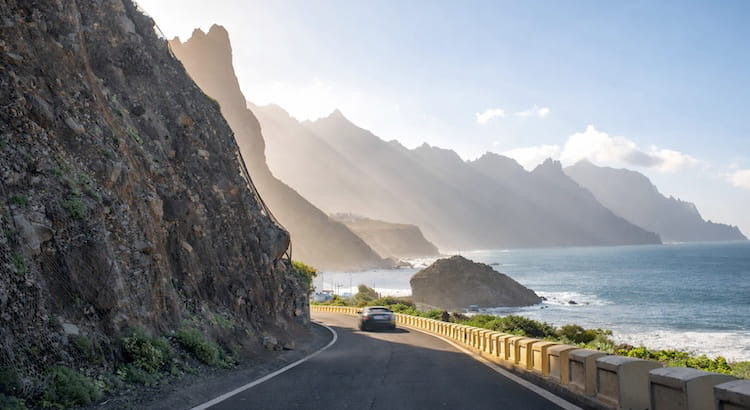
The “best” airport is the one that matches your landing time, return time, and the roads you’ll drive most (mountain switchbacks to Masca, misty northern routes to Anaga, or mostly motorway cruising on the TF-1).
Key takeaways
- • Choose your car rental airport by where you’ll sleep most nights: south resorts = TFS, north towns = TFN.
- • TFS is the island’s bigger airport, which can mean more choice but also bigger peak-time crowds; TFN is often calmer but has more weather sensitivity.
- • After-hours returns aren’t the same everywhere; confirm “key drop/out-of-hours return” for your specific company and location before you pay.
- • North routes can be wetter and foggier; if you plan Anaga or lots of mountain driving, prioritize visibility, tires, and power over “smallest possible car.”
TFS vs TFN in one minute: match the airport to your trip base
The simplest way to decide is to picture your first and last hour on the island.
If you land, pick up keys, and then immediately drive 45–90 minutes “past” your hotel area, you’ve picked the wrong airport for your base.
- Pick up at TFS if you’re staying around Costa Adeje, Playa de las Américas, Los Cristianos, Golf del Sur, or El Médano.
- Pick up at TFN if you’re staying around Puerto de la Cruz, La Laguna, Santa Cruz, or the northern coastal villages.
- Consider “split rentals” (pick up at one airport, return at the other) if your itinerary genuinely changes base mid-trip.
Tenerife’s two-airport setup exists partly because TFN (Los Rodeos) is more exposed to low visibility events, while the south tends to be clearer.
In practice, this matters for planning: if you have a tight schedule on your last day, you’ll want a return plan that is resilient to delays and doesn’t add a stressful cross-island drive.
Flight schedules and arrival patterns: why landing time changes everything
TFS is the primary airport for many international arrivals and handles higher passenger volumes overall, so it tends to have more desks, more fleets, and more competition.
Aena’s 2025 network statistics list Tenerife Sur (TFS) at roughly 14 million passengers in 2025, and Aena’s airport pages show TFN handled about 6.8 million passengers in 2024 (with TFS higher). These differences are one reason TFS can feel busier at peak waves of arrivals.
- If you land late evening, prioritize an airport pickup with clear instructions and a realistic desk closing time.
- If you land midday on a Saturday, expect higher demand and potentially longer lines at both airports.
- If you’re flying inter-island or domestic, TFN often has more of those schedules, so it can be convenient for north-based trips.
Also note TFN’s weather profile.
Local news reports regularly cover fog at Tenerife North causing delays and diversions, which can push a “quick pickup” into a late arrival at the desk.
Queues and pickup experience: what to do if you hate waiting
Queue time is usually not about the island; it’s about landing “waves,” staffing, and how many people need contract changes at the desk.
Because TFS is larger and often receives multiple international flights close together, it can see heavier spikes, even if more companies operate there.
Use these tactics to reduce waiting at either airport:
- Choose a supplier that allows pre-registration/online check-in where available.
- Bring a credit card in the main driver’s name and confirm the deposit rules.
- Add your flight number so the company can track delays (some suppliers explicitly ask for it).
- Book the correct pickup time (not “wishful thinking”), so your reservation matches reality.
If minimizing queues is your top priority, another practical approach is to compare “in-terminal” desks versus shuttle-based locations, then decide what you value more: less walking or less waiting.
After-hours returns and early flights: don’t assume key drop exists
Early departures are common, and a 07:00–08:00 flight can force a 04:30–06:00 car return.
Here’s the catch: after-hours returns are policy-specific.
Some brands and locations clearly state that a key drop box is not available and vehicles cannot be left outside opening hours at that location.
Other suppliers allow out-of-hours returns but state the renter remains responsible until staff receive the vehicle when the office opens again.
- At TFN: some providers publish “no drop box” rules for that location, so verify before you book if you have a dawn flight.
- At TFS: more late/early international traffic often means more established early-return workflows, but you still must confirm for your exact company.
If you need an out-of-hours return, don’t rely on forum anecdotes.
Look for the policy on the rental company’s location page or terms, and take a screenshot of the instructions in case signage is confusing on return night.
Driving conditions you’ll actually face: TF-1 speed vs north weather and mountain roads
Tenerife is small on a map but feels “big” when you’re driving mountain roads at night, in rain, or behind slow vehicles.
Your airport choice affects which motorway you’ll use first:
- From TFS, you typically connect quickly to the TF-1, the main fast route linking the south with Santa Cruz and beyond.
- From TFN, you’re close to the TF-5 corridor, which connects Santa Cruz, La Laguna, and Puerto de la Cruz.
What visitors often underestimate is the north’s microclimate.
The north (especially higher roads near La Laguna and the Anaga area) can be wetter and foggier, and TFN itself can be affected by fog-related delays.
And then there are the “bucket list” drives, which are more about road type than distance:
- Teide: long climbs and descents; power and good brakes matter more than a tiny engine.
- Anaga (Rural Park): narrow, twisty, sometimes wet roads; visibility and confidence matter.
- Masca: steep switchbacks and tight passing points; choose a car you can place accurately on the road.
If most of your driving is south coast resorts + motorway, you can prioritize fuel economy and ease of parking.
If you plan multiple mountain days, prioritize a comfortable driving position, decent power, and good lighting for early mornings or late returns.
Vehicle choice by itinerary: what to rent (and what to avoid)
The “best” rental car in Tenerife is the one that matches your passengers, luggage, and terrain without making parking miserable.
- Mostly south resorts + TF-1: compact automatic or manual, 5 doors, good A/C.
- North base + Anaga + rural viewpoints: compact but not underpowered; prioritize visibility and handling.
- Teide at sunrise or winter evenings: consider stronger headlights and a car that feels stable on long descents.
- Masca and other narrow routes: avoid oversized SUVs unless you’re experienced on tight roads.
Do you need a 4x4?
For typical tourist routes on paved roads, most people don’t, but a slightly higher ride height can improve confidence on rougher access roads and steep driveways.
What matters more is tires, brakes, and driver comfort, because those are the parts you “feel” every minute on Tenerife’s climbs and descents.
Quick checklist: choosing TFS vs TFN for car rental
- Where will you sleep most nights: south resorts or north towns?
- What time do you land (and in what season)?
- What time is your return flight, and do you need an out-of-hours drop?
- Will your first drive be a simple motorway run or a mountain road at night?
- Are you planning Teide, Anaga, or Masca (or all three)?
- Do you want to avoid cross-island driving on day 1 and day last?
What to ask before booking (so there are no surprises)
- Is there an after-hours return at this exact airport location, and how does it work?
- What happens if my flight is delayed past desk closing time?
- Is the rental full-to-full, and where is the nearest fuel station for a stress-free return?
- What deposit is required, and which cards are accepted?
- Are additional drivers included, and can I add them at the desk without delays?
- Can I pick up at TFS and drop at TFN (or the reverse), and what is the one-way fee?
- What roads or areas are restricted (unpaved roads, certain viewpoints, etc.)?
- What’s the process if I get a scratch on a tight mountain road?
How MiTenerife can help you compare offers fast
If you already know your base (south vs north) but you’re stuck choosing a supplier, it helps to compare offers that match your exact landing and return times.
On MiTenerife you can post one request with your airport (TFS or TFN), dates, and itinerary notes (Teide/Anaga/Masca), then compare multiple local offers without contacting companies one-by-one.
If you want to start now, visit mitenerife.com to get the best offers within 1 hour.